Gurgaon Real Estate | Investment Due Diligence Guide
How to Check If a Gurgaon Real Estate Project Is Safe to Invest In: A Complete Due Diligence Checklist for Homebuyers and Investors
Gurgaon - officially Gurugram - has evolved into one of India's most dynamic real estate markets. While opportunities abound, the market carries real risks. If you do your property due diligence properly, you dramatically reduce your exposure to delayed possessions, litigation, and builder insolvencies.
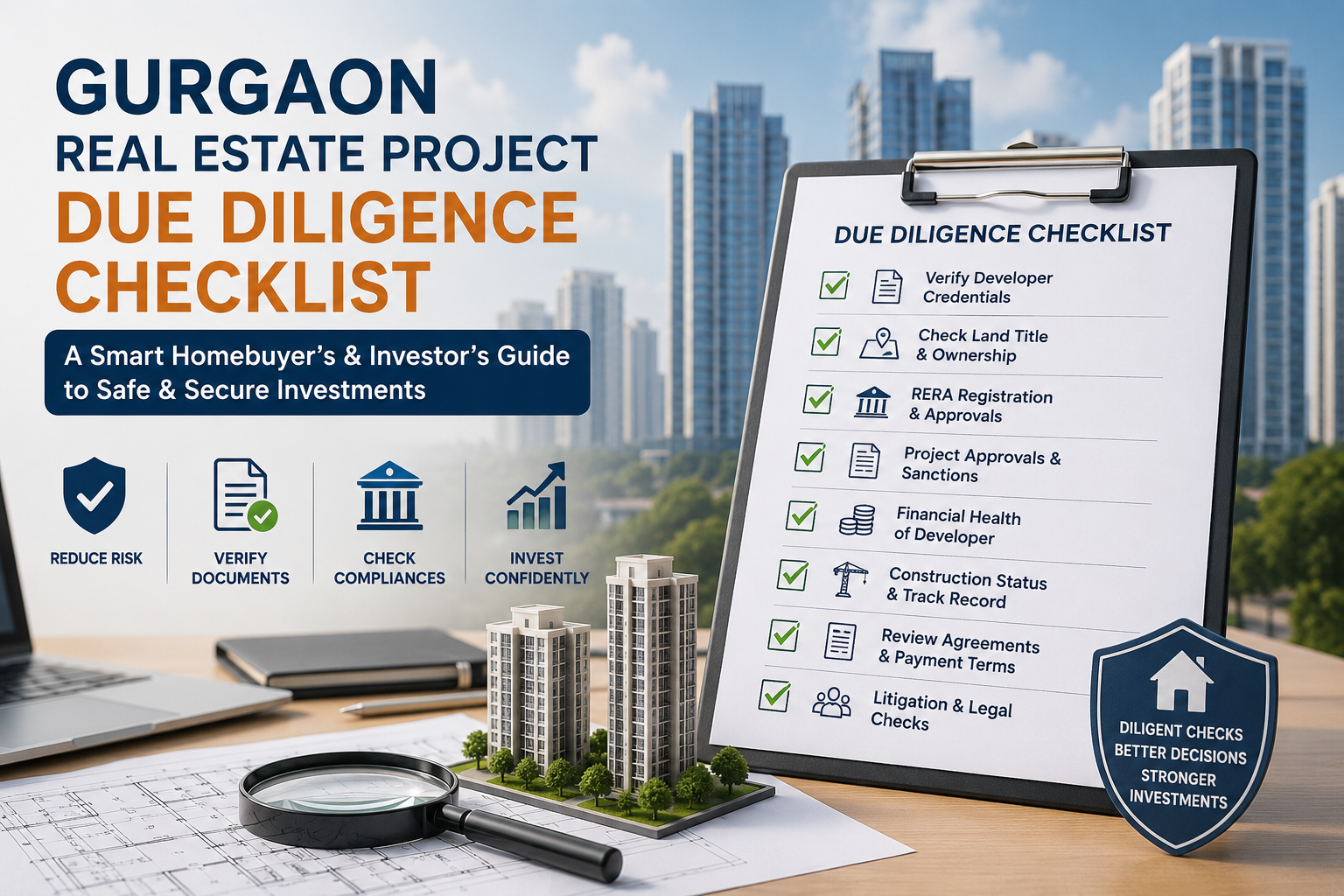
Gurgaon — officially Gurugram — is no longer just a satellite city of Delhi. Over the past two decades, it has evolved into one of India's most dynamic real estate markets, attracting Fortune 500 companies, global MNCs, and hundreds of thousands of urban professionals. Dwarka Expressway has transformed from a dusty stretch to a luxury corridor. Golf Course Extension Road now rivals South Delhi for prestige. And the SCO commercial model has reshaped how retail and office spaces work here.
This explosive growth has attracted serious investors - from NRIs remitting dollars and pounds into Gurgaon Luxury apartments, to first-time homebuyers stretching their savings to lock in a flat. But alongside the opportunity, the market has always carried risk. Delayed possessions, litigation-ridden land parcels, builder insolvencies, and outright fraud have cost buyers crores over the years.
The good news? If you do your homework properly - what real estate professionals call property due diligence - you dramatically reduce your exposure to these risks. This guide is designed to help you do exactly that. Think of it as having an experienced property consultant sitting across the table, walking you through every step before you sign anything or wire any money.
Whether you are a first-time buyer, an NRI investor, a luxury apartment seeker, or simply someone tired of generic advice, this checklist will give you actionable clarity.
Why Buyers Lose Money in Gurgaon Real Estate
Before we get to the checklist, it helps to understand the landscape of risk. These are not hypothetical scenarios — many of these situations have played out in Gurgaon's real estate courts and consumer forums over the past decade.
1. Projects Built on Disputed or Illegal Land
Some of the most painful cases in the Gurgaon market involved buyers purchasing flats in towers built on land with unclear title or without proper government approvals. In several instances in sectors along the Northern Peripheral Road (now Dwarka Expressway), courts ordered stays on construction or even demolition of structures because the developer did not have clear possession of the land. Buyers were left holding agreements worth crores, fighting cases for years.
2. Builders Selling Unregistered Projects
Prior to RERA, developers routinely launched and sold projects without any regulatory oversight. Even after HRERA (Haryana's state RERA) became operational, some developers found ways to delay registration or sell pre-launch inventory before filing. Buyers who purchased at this stage had little legal protection when things went wrong.
3. Possession Delays Running into Years
Gurgaon has one of the highest concentrations of delayed real estate projects in North India. Projects that promised possession in 2018 or 2019 were still under construction in 2024. Buyers were paying both EMIs and rent simultaneously — a financial double burden that stretched families for years.
4. Hidden Charges and Escalating Costs
Many buyers sign agreements based on a base price per square foot, only to discover later that Preferential Location Charges (PLCs), infrastructure development charges, club membership fees, and other add-ons inflate the final cost by 20–30%. Some payment plans with "assured returns" have turned out to be completely unsustainable constructs.
5. Builder Insolvency
When a developer runs into financial trouble — whether from mismanagement, over-leveraging, or legal disputes — buyers are among the last to know. By the time NCLT proceedings begin, the project may be half-built and the money long spent. Several prominent Gurgaon developments went through insolvency proceedings under IBC, leaving thousands of buyers in uncertainty.
Understanding these failure modes is the first step. The checklist below is designed to systematically screen for each of them.
Step-by-Step Gurgaon Property Due Diligence Checklist
This is not a theoretical list. Every item here reflects a real question that a property lawyer, a bank's legal team, or an experienced investor would ask before committing funds. Go through each section carefully.
HRERA Verification
The first thing you should do is check the project's HRERA status. HRERA (Haryana Real Estate Regulatory Authority) is the state's regulatory body, and every project with more than 500 sq. m. of plot area or more than 8 apartments must be registered. Search by name or developer on hrera.org.in to confirm active status.
Land Ownership & Title
A clean land title means the developer actually owns the land free of disputes, mortgages, or competing claims. Hire an independent property lawyer to conduct a title search going back at least 30 years to review revenue records (jamabandi), mutation records, and sale deeds.
CLU & License Check
In Haryana, residential development requires a Change of Land Use (CLU) certificate and a license from DTCP (Department of Town and Country Planning, Haryana). Ask the developer to share their DTCP license and CLU sanction letter, and cross-verify details on the DTCP Haryana portal.
Encumbrance Certificate
An Encumbrance Certificate (EC) confirms that the property is free from any monetary or legal liabilities like mortgages or court attachments. Obtain the EC from the area's Sub-Registrar. If mortgaged to a bank, ensure a protective tripartite agreement is in place.
Environmental Clearance
Residential projects above a certain size require Environmental Clearance (EC) from MoEFCC or SEIAA. This is highly critical near Gurgaon's ecologically sensitive Aravalli range. Ask for the EC document and verify it on the Parivesh portal (parivesh.nic.in).
Approved Building Plan
What is being built must match what has been approved by the municipal authority. Demand to see the approved building plan sanctioned by MCG or relevant authority, floor plans for the specific tower, Fire NOC, and Airport Authority height clearance (AAI) if applicable.
Builder Track Record
Visit completed projects of the developer and talk to residents about snag timelines and maintenance quality. Search the developer's name on hrera.org.in under the complaints section, look up Consumer Forum (NCDRC) orders, and check for any NCLT insolvency filings.
Developer Financial Health
Verify that the developer is financially stable. Review annual reports and credit ratings for listed companies, or check MCA filings for private ones. Under RERA, 70% of collections must go into a dedicated project escrow account. Ask for evidence of compliance.
Bank Approvals
Bank-approved projects in Gurgaon carry an implicit level of due diligence. PSU banks and major private banks like SBI, HDFC, and ICICI conduct extensive legal reviews before approving home loans. A project approved by multiple major banks is a positive signal.
Construction Inspection
Visit the site. Observe the pace of construction, number of workers on site (a half-staffed site is a warning sign), and use of branded materials. For ready-to-move projects, consider hiring an independent snagging expert to assess finishes and structural health.
Possession Timeline
Cross-check the promised possession date in the marketing brochures against the HRERA-declared possession date, the current stage of construction, the builder's historical delivery record, and the penalty clauses in the builder-buyer agreement (BBA).
Legal Agreement Review
Never sign a builder-buyer agreement without an independent lawyer's review. Scrutinize carpet area definitions, force majeure definitions, delay penalties (should be matching RERA guidelines), cancellation/refund policies, and dispute resolution mechanisms.
Hidden Charges Scrutiny
Request a complete cost sheet, not just the base price. Account for Preferential Location Charges (PLCs), Infrastructure Development Charges (IDC), External Development Charges (EDC), club membership, power backup, IFMS, GST, and stamp duty.
OC & CC Status
For ready-to-move properties, the Occupation Certificate (OC) is non-negotiable. Without an OC issued by MCG or the competent authority, you cannot get legal utility connections, register the property properly, or resell it easily in the future.
Resale & Rental Potential
Even for self-use, evaluate strong resale potential and rental yields in the micro-market (typically 2.5–4% in Gurgaon). Check comparable prices on major portals, assess proximity to upcoming metro corridors and corporate employment hubs, and verify circle rates.
"Expert Tip: Developers sometimes register a Phase 1 with HRERA and then quietly sell Phase 2 or Phase 3 without separate registrations. Always confirm which specific phase and tower you are buying in, and verify that phase's registration separately."
Understanding Hidden Charges in Gurgaon Property Deals
Developers routinely use off-the-cuff base price discounts to entice buyers. However, add-on charges can inflate your final outflow by 20–30%. Review the typical structure below to build an accurate all-inclusive comparison:
| Charge Type | Typical Range | Negotiable? |
|---|---|---|
| Preferential Location Charge (PLC) | ₹100–₹500 per sq ft | Sometimes |
| Infrastructure Development Charge (IDC) | ₹50–₹200 per sq ft | Rarely |
| External Development Charge (EDC) | ₹50–₹150 per sq ft | No (government-levied) |
| Club Membership Fee | ₹1–₹5 lakh | Sometimes |
| Power Backup / DG Charges | ₹50,000–₹2 lakh | Rarely |
| IFMS / Maintenance Deposit | ₹50–₹100 per sq ft | No |
| GST (on under-construction) | 5% of base price | No (statutory) |
| Stamp Duty & Registration | 5–7% of circle rate | No (statutory) |
Red Flags That Indicate a Risky Gurgaon Real Estate Project
Even without deep legal knowledge, certain signals should make any buyer pause. Train yourself to notice these:
Key Red Flags for Gurgaon Property Buyers
- No HRERA number: Any developer who cannot immediately provide a valid, active HRERA registration number for the project you are buying in should be a non-starter. Period.
- Price significantly below market rate: If a project is priced 20–30% below comparable developments in the area, ask why. Distress pricing, hidden land litigations, or poor construction quality are common reasons.
- High-pressure sales tactics: "This offer expires tonight" or "Only 2 units left" in a 500-unit project are manipulative pressure tactics. Legitimate developers do not need to do this.
- Vague or evasive responses to legal questions: If the sales team cannot answer basic questions about HRERA registration, CLU, or OC status — or redirects you to "talk to the legal team after booking" — walk away.
- Poor or fake online reviews: Look at Google reviews, Housing.com, and real estate forums. A flood of 5-star reviews posted on the same dates is suspicious. Look for genuine, detailed reviews — including negative ones about delays and maintenance.
- Ongoing litigation involving the project land: A case pending in court about the land on which your building stands is a serious risk. Legal resolutions can take years and may stop construction entirely.
- "Assured return" schemes: Promises of 9–12% assured returns on under-construction property are almost always unsustainable and have a documented history of ending badly in Gurgaon.
- Developer with multiple HRERA complaints: A builder with dozens of active complaints on the HRERA portal has a systematic problem — not just a few unhappy customers.
How NRIs Can Safely Invest in Gurgaon Real Estate
For non-resident Indians, investing in Gurgaon property from abroad adds an extra layer of complexity. You are often relying on brokers, relatives, or developers without being physically present to verify anything. Here is how to protect yourself:
- 1. Appoint a Trusted Power of Attorney (PoA): Your PoA holder should be someone you completely trust — and ideally not the broker selling you the property. The PoA should have clearly defined and limited powers. An open-ended PoA can be easily misused.
- 2. Use FEMA-Compliant Payment Channels: All remittances for property purchase must come through NRE or NRO accounts. Maintain clear documentation of funds transferred, as you will need this for future repatriation of sale proceeds. Cash transactions are highly illegal and expose you to serious legal risk.
- 3. Hire an Independent Property Lawyer: Not the developer's lawyer. Not the broker's recommended lawyer. An independent lawyer who reviews all documents, conducts the title search, and advises you on agreement terms. The cost — typically ₹25,000 to ₹75,000 — is trivial relative to the transaction size.
- 4. Verify Everything Digitally: HRERA portal, DTCP portal, Parivesh, and MCA — all are accessible online. An NRI can verify most critical documents independently without needing to be in Gurgaon. Insist that all documents be shared in soft copy with original signatures for physical verification later.
- 5. Understand TDS Obligations: When buying from a developer, TDS is typically not applicable. But if buying in resale from an NRI seller, TDS at 20–30% of the sale value may apply. Get this clarified by a CA before finalizing the deal.
Expert Tips Before Buying Luxury Apartments in Gurgaon
The luxury segment in Gurgaon — typically apartments priced above ₹3 crore — has its own set of considerations beyond the standard checklist.
1. Luxury Pedigree
Evaluate the developer's luxury pedigree. Has the developer delivered luxury products before? Luxury is not just price — it is finish quality, spatial design, amenity depth, and post-possession service. Visit completed luxury projects by the same developer before committing.
2. Amenity Sustainability
A project with 50 amenities spread across a small number of units often ends up with high maintenance costs and underused facilities. Evaluate whether the amenity provision is proportional to the project scale.
3. Clubhouse Commitments
What exactly is being promised in the clubhouse? Get specifics in writing — and check if any part of it is a third-party commercial venture rather than a residents-owned facility.
4. Branded Residences
Some luxury projects carry a hotel brand for concierge and facility management. Understand the revenue-sharing model if hotel rooms are part of the proposition, and get legal clarity on title.
5. Check the Peer Set
Who else is buying in this project? For luxury real estate, the socioeconomic profile of your future neighbors significantly affects community quality and resale value.
Gurgaon Areas with Strong Investment Potential in 2026
Gurgaon is not monolithic. Different micro-markets offer very different risk-return profiles. Here is a sector-by-sector reality check:
Dwarka Expressway
Golf Course Extension Road
Southern Peripheral Road (SPR)
New Gurgaon
Old Gurgaon Hinterland
The Ultimate Gurgaon Property Verification Checklist (Print & Use)
Use this as your working checklist when evaluating any Gurgaon real estate investment. Print it or save it for every project you evaluate.
1. Legal & Regulatory
- HRERA registration verified on hrera.org.in
- HRERA registration covers the specific phase/tower
- CLU certificate obtained and valid
- DTCP License number verified
- Environmental clearance verified on Parivesh portal
- Approved building plan obtained
- Fire NOC obtained
- AAI height clearance (if applicable)
2. Land & Title
- 30-year title search conducted by independent lawyer
- Revenue records (jamabandi) reviewed
- Mutation records confirmed
- Encumbrance Certificate obtained
- No agricultural land conversion issues
- Tripartite agreement in place (if land is mortgaged to a bank)
3. Builder Verification
- Past project delivery record reviewed
- HRERA complaints search conducted
- Consumer forum and NCLT records searched
- MCA filings reviewed for financial health
- ESCROW account compliance confirmed
- Existing residents interviewed (for completed/near-complete projects)
4. Project & Construction
- Site visit conducted
- Construction pace assessed against timeline
- Construction quality reviewed (or independent engineer engaged)
- Bank loan approval confirmed for home loans
- Occupation Certificate status confirmed (for ready projects)
5. Financial & Commercial
- Full cost sheet (all-in) obtained and reviewed
- Circle rate vs. market rate gap assessed
- Comparable resale/rental rates researched
- Payment plan terms reviewed for risk
- All charges (IDC, EDC, PLC, IFMS) accounted for
6. Agreement Review
- Builder-buyer agreement reviewed by independent lawyer
- Carpet area vs. super built-up area ratio assessed
- Possession penalty clauses confirmed as meaningful
- Force majeure clauses reviewed
- Refund and cancellation policy understood
- Dispute resolution mechanism reviewed
Frequently Asked Questions: Gurgaon Property Due Diligence
1. How do I verify a Gurgaon real estate project before investing?
Begin on the HRERA portal (hrera.org.in) to confirm registration. Then hire a property lawyer for title search and land ownership verification. Check CLU from DTCP Haryana, environmental clearance on Parivesh, and the builder's track record through HRERA complaints and consumer forum records. Never skip the independent lawyer review of the agreement.
2. Is HRERA registration enough before investing in Gurgaon?
No. HRERA registration is a necessary first check, not a sufficient one. It tells you the project is registered but does not guarantee clear land title, proper CLU, environmental clearance, or that the developer is financially capable of completing the project. Treat HRERA as Step 1 of a 15-step process.
3. How do I check builder credibility in Gurgaon?
Research past projects they have delivered. Visit a completed project and speak to residents directly. Check HRERA complaint records, search consumer forum (NCDRC) orders, look for any NCLT insolvency proceedings, and review news coverage over the past 5 years.
4. Which documents are mandatory before buying a flat in Gurgaon?
At minimum: HRERA registration certificate, CLU and DTCP license, approved building plan, environmental clearance, title search report (prepared by your lawyer), encumbrance certificate, and — for ready-to-move properties — the Occupation Certificate.
5. What are the warning signs of a risky real estate project?
No HRERA registration, pricing significantly below market, aggressive sales pressure, evasive responses to legal questions, multiple complaints on HRERA portal, no bank loan approvals, ongoing litigation on project land, and "assured return" promises.
6. How do banks verify real estate projects before approving home loans?
Banks conduct their own legal due diligence including title verification, CLU/license check, HRERA registration confirmation, and assessment of project viability. However, banks assess lending risk — not buyer risk — and their approval should not be your only comfort.
7. What is an Occupation Certificate and why does it matter?
An Occupation Certificate (OC) is issued by the municipal authority (MCG for most of Gurgaon) confirming that the building has been constructed as per approved plans and is legal for habitation. Without OC, you cannot get legal utility connections and face risks during resale or registration.
8. Can NRIs safely invest in Gurgaon real estate from abroad?
Yes, with proper precautions: appoint a trusted, limited-scope PoA, use FEMA-compliant NRE/NRO payment channels, hire an independent lawyer for document verification, and verify all regulatory approvals digitally. Avoid any cash component in the transaction.
9. What is the CLU and why is it important for Gurgaon property?
CLU (Change of Land Use) is a certificate from the Haryana government authorizing the conversion of agricultural or other land to residential use. Without CLU, residential construction on such land is illegal and the buyer's ownership can be challenged in court.
10. How do I check the HRERA registration of a Gurgaon project online?
Visit hrera.org.in, navigate to the project search section, and search by project name or developer name. You will see the registration details, declared possession date, number of units registered, and any complaints filed. Always ask the developer for the specific HRERA number and verify it yourself — do not rely on brochure claims.
11. What are the common real estate investment mistakes Gurgaon buyers make?
Skipping independent legal advice, not verifying HRERA registration, relying solely on bank approval as a legal safety net, ignoring hidden charges in cost computation, not visiting the site during construction, and trusting verbal commitments that are not in the agreement.
12. What is the significance of the encumbrance certificate in property purchase?
An encumbrance certificate confirms the property is free from financial and legal liabilities — mortgages, loans, court attachments. It is obtained from the Sub-Registrar's office and is essential for both clean purchase and future mortgage or resale transactions.
Conclusion: Invest Smart, Invest Safe
Gurgaon remains one of India's most compelling real estate markets in 2026. The fundamentals — corporate employment depth, infrastructure investment, lifestyle infrastructure, and connectivity — continue to support long-term demand. The market has also matured significantly since the pre-RERA era, with stronger regulatory oversight and greater transparency.
But maturity does not mean risk-free. The checklist in this guide exists because buyers who skip due diligence still suffer — delayed projects, litigation, financial loss. The difference between a safe investment and a nightmare is almost always the due diligence done before signing.
A few principles to carry with you:
- No project is so good that it does not deserve verification
- No discount is large enough to justify skipping legal checks
- An independent property lawyer's fee is the cheapest insurance you can buy
- Regulatory portals are free — use them before every decision
- If something feels rushed or evasive, it usually is
Real estate investment in Gurgaon, when done with discipline and proper due diligence, can genuinely build generational wealth. The city's trajectory is upward. The infrastructure is being built. The demand is real. Your job as a buyer is simply to make sure the specific project you choose is legally sound, financially viable, and delivered by a developer who has earned your trust.
Take your time. Do the work. And when in doubt — consult a qualified property lawyer and an independent financial advisor before you commit.
Verify Your Gurgaon Real Estate Investment
Ready to verify a specific Gurgaon project? Start with HRERA registration today - and if you need expert guidance on property due diligence, reach out to our advisory team for a confidential consultation.
Before making any real estate investment decision in Gurgaon, consult trusted experts like Property Station to ensure complete property due diligence, legal verification, and safer investment planning.
Let Our Experts Guide Your Investment Due Diligence
Avoid expensive mistakes. Get a free document review and connect with Gurgaon's best certified property lawyers and snagging specialists today.
Disclaimer: The checklists, estimates, and legal parameters outlined in this guide represent industry best practices for property buyers in Gurgaon. Circle rates, RERA policies, and taxes are subject to revisions by the government. Always consult a legal expert and a certified financial advisor before signing final builder-buyer agreements or making property payments.