Real Estate Investment · Gurgaon · Infrastructure Boom
How Dwarka Expressway, SPR & RRTS Are Increasing Gurgaon Property Prices in 2026
Gurgaon's infrastructure boom is rewriting the property map, compressing commute times, unlocking new corridors, and driving double-digit appreciation.
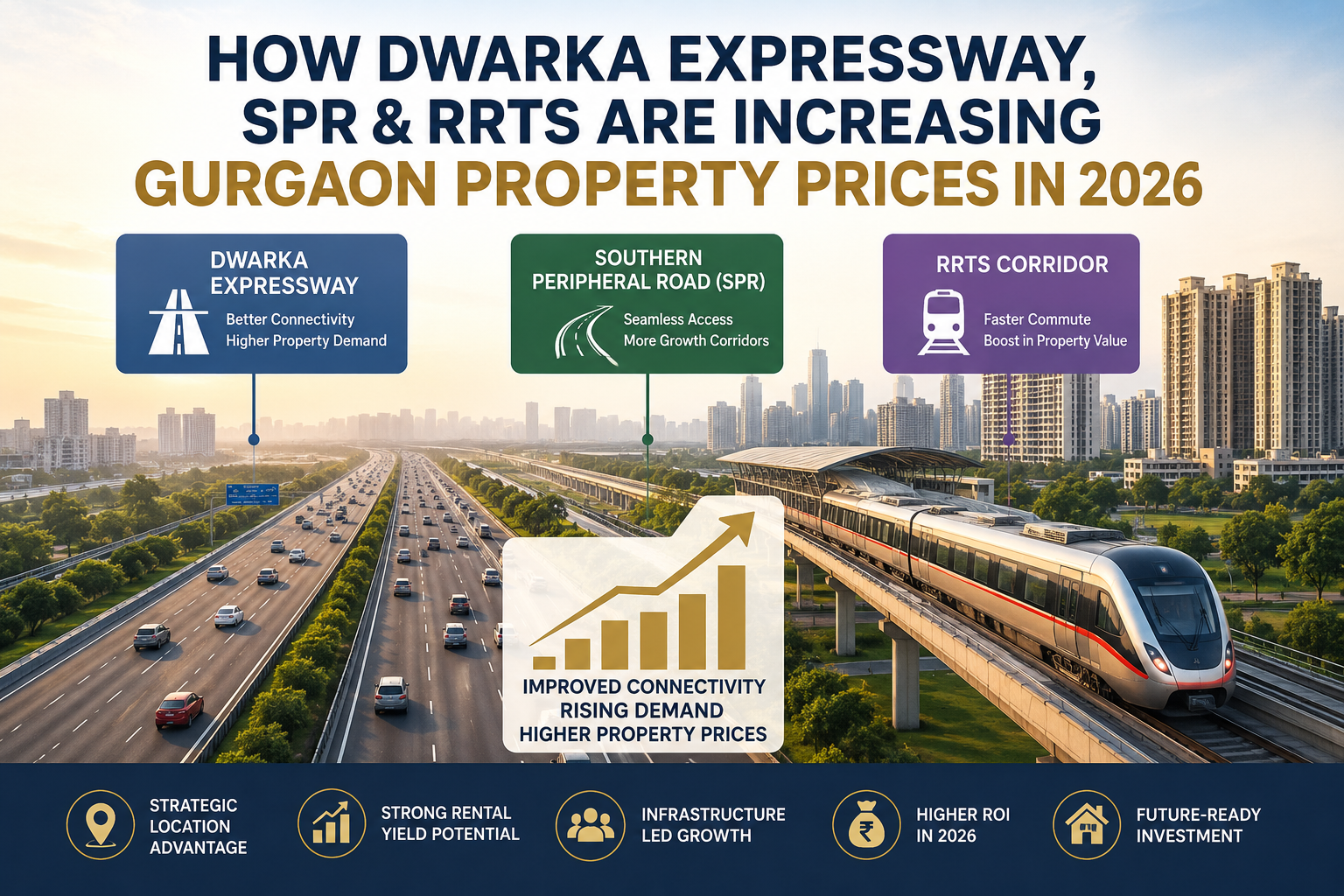
If you've been watching the Gurgaon real estate market in 2026, one thing is crystal clear - infrastructure is the most powerful price driver in the city right now.
Three mega-projects are at the heart of this transformation: Dwarka Expressway, the Southern Peripheral Road (SPR), and the Regional Rapid Transit System (RRTS). Together, they are compressing commute times, unlocking new corridors, and making previously overlooked sectors the hottest addresses in the National Capital Region (NCR).
For homebuyers, this means better-connected homes at prices that are still appreciating. For investors, it signals one of the most compelling windows for property investment in Gurgaon in recent memory.
Here's everything you need to know.
"Road and rapid transit integration is not just about moving people faster; it's about shifting the gravitational pull of luxury real estate in Gurugram."
The Infrastructure Anchors Transforming Gurgaon
What Is Dwarka Expressway and Why Does It Matter?
The Dwarka Expressway - officially called the Northern Peripheral Road - is an 18-km, eight-lane elevated highway connecting Dwarka in Delhi to NH-48 (Delhi-Gurgaon Expressway) via sectors 99 to 115 in Gurgaon. Since its full operationalisation, it has become the spine of northwest Gurgaon's property boom.
Dwarka Expressway property prices have jumped significantly. Average residential prices along this corridor now range between ₹9,500 and ₹15,000 per sq. ft., depending on the sector and project type - a rise of nearly 28–35% over the past two years, according to market reports.
Why Are Buyers Flocking to Dwarka Expressway Projects?
- Direct access to IGI Airport in under 20 minutes
- Seamless connectivity to Cyber City, Udyog Vihar, and Manesar
- Close proximity to Delhi's Dwarka sub-city and Diplomatic Enclave
- Rapid development of social infrastructure - schools, hospitals, malls
- Wide availability of flats near Dwarka Expressway in the luxury and mid-premium segments
Sectors 99, 102, 103, 106, 108, 109, and 113 have emerged as investor favourites. Projects by DLF, Sobha, M3M, Godrej, and Signature Global have seen strong pre-launch and resale demand. The corridor is no longer "upcoming" - it's arrived.
Understanding the Southern Peripheral Road's Impact
The Southern Peripheral Road (SPR) Gurgaon stretches approximately 16 km, connecting NH-48 near Rajiv Chowk to Golf Course Extension Road and further towards Faridabad. What makes SPR special is its positioning at the intersection of Gurgaon's luxury real estate ecosystem.
SPR Gurgaon real estate has attracted some of the most premium residential launches in the NCR. Sectors 65, 66, 67, 68, 69, 70, 71, and 72 sit along this corridor, hosting ultra-luxury apartments, high-rise condominiums, and plotted developments that cater to CXOs, NRIs, and HNI buyers.
Why SPR Is a Magnet for Premium Projects
The SPR advantage is not just about roads - it's about the lifestyle ecosystem around it:
- Golf Course Extension Road - one of Gurgaon's most aspirational addresses - feeds into SPR
- Close to Sohna Road, adding depth to the investable corridor
- Excellent access to IT/ITES employment hubs in sectors 62–65
- Surrounded by top-tier schools, fine dining, and premium healthcare facilities
- Luxury apartments in Gurgaon along SPR have clocked 20–30% capital appreciation in 24 months
Developers including Emaar, Sobha, Central Park, and BPTP have launched or are delivering premium projects in Gurgaon along SPR, with ticket sizes ranging from ₹3 crore to ₹15+ crore. The demand from end-users - not just investors - gives this micro-market exceptional stability.
What Is RRTS and How Does It Impact Gurgaon Real Estate?
The Regional Rapid Transit System (RRTS) is a semi-high-speed rail network being developed under the National Capital Region Transport Corporation (NCRTC). The Delhi–Gurugram–SNB (Shahjahanpur–Neemrana–Behror) corridor is one of the most anticipated upcoming infrastructure projects in Gurgaon.
Once fully operational, RRTS connectivity Gurgaon will enable travel from Gurugram to central Delhi in under 30 minutes at speeds of up to 180 km/h. This is transformational.
How RRTS Is Already Moving Property Prices
Even before full operationalisation, the announcement effect of RRTS has been powerful:
- Areas along the proposed alignment - including sectors in New Gurgaon and Manesar - have seen 10–18% price appreciation in anticipation
- The New Gurgaon property market, covering sectors 76–95 and beyond, is particularly energised
- RRTS stations will act as micro-market anchors, much like Metro stations have in Delhi and Noida
- Institutional investors and large developers are already acquiring land parcels near proposed RRTS corridors
RRTS Gurgaon is not just a commuter project - it is a real estate value creator. Every station on the alignment will unlock fresh micro-markets, and early buyers in these zones are positioned for strong long-term real estate appreciation in Gurgaon.
Top Sectors to Invest in Gurgaon in 2026
Given the infrastructure tailwinds, here are the best sectors to invest in Gurgaon right now, categorized by their primary infrastructure driver:
Dwarka Expressway
Along SPR
New Gurgaon & Transit
Why Investors Are Doubling Down on Gurgaon in 2026
The Gurgaon real estate market in 2026 is not a speculative play - it is fundamentally supported by multiple converging factors:
Employment Depth
Gurgaon houses the India headquarters of over 250 Fortune 500 companies. This massive corporate engine generates structural, non-speculative demand from highly compensated working professionals.
Infrastructure ROI
Every major road or transit project in Gurgaon has historically delivered a massive 15–40% capital appreciation in adjacent micro-markets within a 3–5 year cycle of completion.
Limited Supply in Premium Segments
While the mid-range supply remains relatively healthy, ultra-luxury inventory is constrained in core locations, keeping price floors solid and supporting steady rental growth.
NRI Interest
A favorable currency conversion and global luxury comparisons are pushing substantial HNI and NRI buying directly into Gurgaon's premium gated residences.
Policy & Regulation Support
Strict Haryana RERA compliance, structural transparency, and streamlined approval protocols have dramatically bolstered domestic and international buyer confidence.
Gurgaon property investment in 2026 is increasingly being seen as a resilient hedge against inflation. With average rental yields reaching 3% to 4.5% on top of steady capital growth, the total return proposition remains incredibly attractive for serious portfolios.
Future Appreciation Potential and Real Estate Trends
What the Data Tells Us About 2026 and Beyond
Looking at real estate trends in Gurgaon 2026, several indicators point to sustained upward momentum:
- Average property prices in Gurgaon rose 22% year-on-year in 2025, and 2026 is tracking similarly strong.
- The luxury segment (₹5 crore+) has outperformed significantly, with 30%+ appreciation in select SPR and Golf Course Extension micro-markets.
- Gurgaon infrastructure growth - including the completion of the Dwarka Expressway, SPR upgrades, and RRTS progress - adds a consistent 5–10% premium to properties in connected sectors.
- Demand for larger homes (3BHK and 4BHK) remains highly elevated, benefiting premium branded developers.
The consensus among leading real estate analysts and developers is that Gurgaon property prices still have a robust 15–25% upside over the next 2–3 years, particularly in early-phase RRTS-adjacent sectors and premium SPR micro-markets.
Is Now the Right Time to Invest in Gurgaon?
The short answer is yes - but with eyes open.
Dwarka Expressway has matured into a delivery-stage market. SPR is in its prime value phase. And RRTS is still in its early appreciation cycle, which means it offers the highest potential upside for patient investors.
Whether you're a first-time homebuyer seeking connectivity and lifestyle, an investor chasing capital appreciation, or an NRI looking at Gurgaon luxury real estate as a long-term asset - 2026 offers a compelling combination of infrastructure maturity, strong fundamentals, and growth momentum.
The best time to invest was five years ago. The second best time is now.
Ready to explore the best projects along Dwarka Expressway, SPR, and RRTS corridors? Connect with a certified real estate advisor to find the right opportunity for your budget and goals.
Frequently Asked Questions (FAQs)
1. How has Dwarka Expressway affected property prices in Gurgaon?
Since becoming fully operational, Dwarka Expressway has driven property prices in adjacent sectors up by 28–35%. Improved connectivity to Delhi, the airport, and key employment hubs has made it one of the most sought-after residential corridors in Gurgaon, with prices now ranging between ₹9,500 and ₹15,000 per sq. ft.
2. Which are the best sectors to invest in along SPR Gurgaon in 2026?
Sectors 65, 66, 67, 68, 70, and 72 along the Southern Peripheral Road are considered the top investment zones in 2026. These sectors offer a mix of luxury apartments, premium plotted developments, and strong rental demand due to proximity to IT hubs and lifestyle infrastructure.
3. What is RRTS and how will it impact Gurgaon real estate?
RRTS (Regional Rapid Transit System) is a high-speed rail corridor connecting Gurugram to Delhi and beyond. Once operational, it will reduce commute times to under 30 minutes. Properties near proposed RRTS stations in Gurgaon and New Gurgaon are already witnessing 10–18% pre-launch appreciation.
4. Is Gurgaon a good place for property investment in 2026?
Yes. Gurgaon offers a rare combination of mature infrastructure, strong employment demand, luxury real estate supply constraints, and upcoming connectivity upgrades via RRTS. Property prices rose 22% year-on-year in 2025, and analysts expect continued appreciation of 15–25% over the next 2–3 years.
5. What is the price range for luxury apartments in Gurgaon in 2026?
Luxury apartments in Gurgaon - particularly along SPR, Golf Course Extension Road, and Dwarka Expressway - range from ₹3 crore to ₹15+ crore. Ultra-luxury penthouses and low-rise villa developments in premium sectors can exceed ₹20 crore, driven by NRI and HNI demand.
Disclaimer: Property prices and appreciation figures mentioned are based on market reports and industry estimates as of early 2026. Actual returns may vary. Always consult a licensed real estate advisor before making investment decisions.